It’s not just a matter of technical capabilities. BIM models are an integral part of the planning process in many places; cloud platforms connect project stakeholders; and artificial intelligence opens up new possibilities for analysing information. But has digitalisation actually made construction more productive, cost-effective and sustainable? The official figures, at least, are open to debate. A study published in October 2026 by the German Institute for Economic Research (DIW Berlin) shows that labour productivity in the German construction industry in 2025 was almost 30 per cent lower than in 2010. There are various economic and structural reasons for this. However, this trend suggests that increased technological capabilities have not yet led to a corresponding increase in productivity.
Productivity in construction — but how?
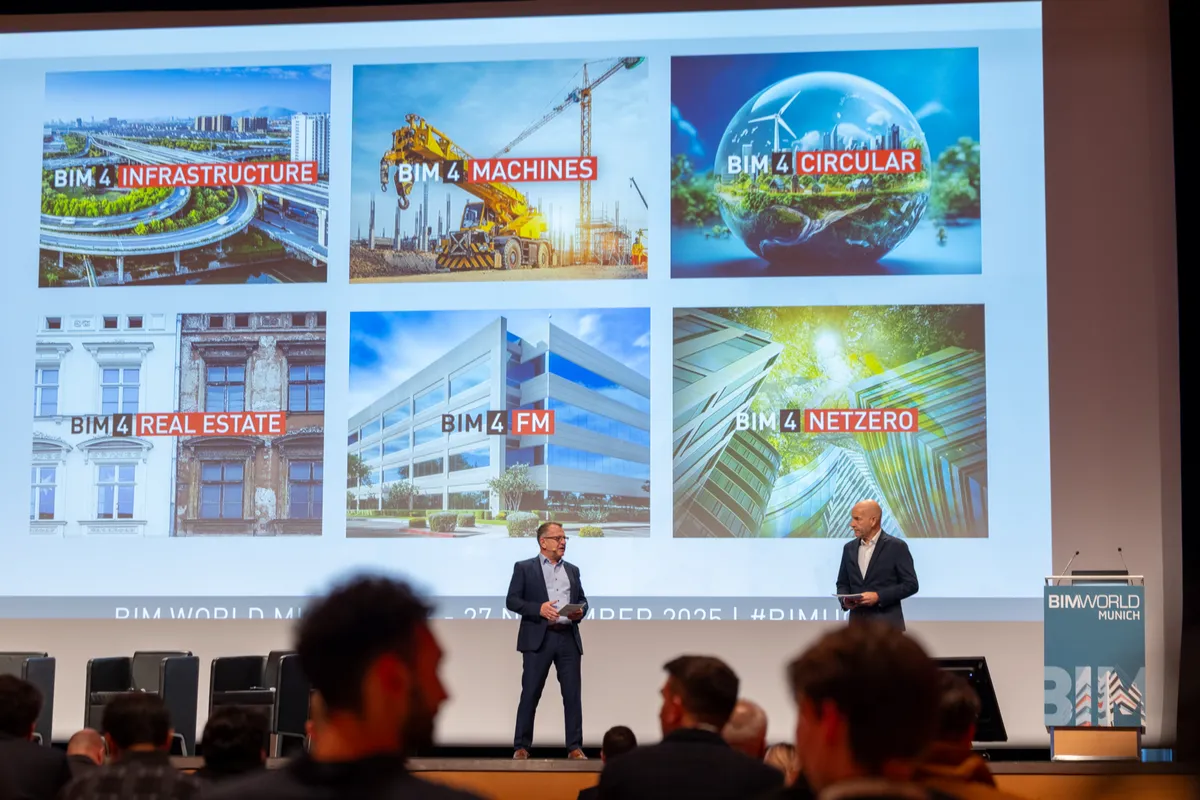
This is, of course, also a key topic at the 10(th) BIM World MUNICH, which will take place on 24 and 25 November at the ICM – International Congress Center Messe München. In his opening keynote, Olaf Demuth, CEO of the ZECH Group and President of the German Construction Industry Association, asks: 'Productivity in construction—but how?' His assessment: The industry has digitised, but has not fundamentally changed its processes. A second wave of transformation is therefore needed to integrate planning and execution more closely and organise digital workflows across the entire value chain.
Dr Ernst Böhm, founder of the B&O Group, specialises in residential construction. In his article, 'Simple Construction Also Means More Affordable Construction', he calls for less complexity and sets ambitious goals: halving construction costs, timescales, and CO₂ emissions while simultaneously doubling the number of apartments built. To this end, he presents six proposals for discussion. These include adding storeys to existing buildings, industrial prefabrication, simplified building standards such as those for Building Type E, tax breaks, and a revised land-use policy. Both positions demonstrate that productivity depends not only on new technologies, but also on planning and construction processes, complexity, and economic and political framework conditions.
The real problem lies in the systems.
Everyday planning practice shows that digital investments do not automatically lead to greater efficiency. Although architects and engineers are increasingly working in a model-based manner, media discontinuities continue to arise between disciplines and companies. Information is exported, reprocessed, or transferred manually. Much of the work still relies on PDF plans, email attachments, and separate applications. At BIM World, Christoph Becker of Bluebeam referred to this as the 'forgotten middle ground between design and construction': the phase in which plans are reviewed, trades are coordinated, and decisions are made. AI could help to access information that has been difficult to obtain until now in a systematic way. This involves more than just reading a plan. The key is recognising interdependencies: Which changes affect other trades? What requirements apply to a building component? Which information remains current after multiple plan revisions?
In order for AI agents to be able to answer such questions reliably, they need consistent, unambiguously assignable and up-to-date data. This is precisely where major challenges have arisen so far. Different software solutions, data formats and inconsistent information structures make it difficult to consolidate and analyse building information. Open standards and interoperable interfaces are therefore becoming increasingly important as AI becomes more widely used. They lay the foundation for ensuring that information remains understandable and usable across system boundaries. Open BIM could therefore be more important for the next stage of digitisation than it has been so far.
How much BIM does a project need?
But how much BIM does a project actually need? Alfonso Monedero of Heatherwick Studio takes a pragmatic stance on this issue. In “A Tale of Three Cities: One BIM Does Not Rule Them All”, the Head of Digital Practice at the London-based architecture firm challenges the assumption that a higher level of BIM maturity inevitably leads to better results. His examples of international architecture range from the automated creation of two-dimensional drawings to the exchange of editable, discipline-specific models and shared digital work environments. He argues that what matters is not the technically achievable BIM level, but the form of collaboration that the project actually requires.
This idea extends far beyond architecture. Not every task requires a digital twin, nor does every process require AI. Technology must solve a specific problem and reduce effort. Given the cost pressures in residential construction in particular, additional modelling and documentation requirements can become an obstacle if they do not facilitate subsequent work steps. Therefore, building more simply does not necessarily mean less digitisation, but rather the more targeted use of it.
The ultimate test takes place on the construction site
It becomes clear on the construction site just how difficult it can be to reuse digital planning information. In 'Outcome Instead of Output: The Construction Site of the Future Thinks in Terms of the Goal', Thomas J. Müller of OpenSpace argues for a change of approach. Construction projects generate vast amounts of data, models and documents. If this information does not feed back into the processes, however, its value is minimal. The important thing is not what was delivered, but whether the agreed goals were achieved. Is the quality up to standard? Was the schedule met? Was the budget adhered to? To ensure this, the as-built condition must be reconciled with the plans. Visual Intelligence links image data from the construction site with planning information, making progress traceable and helping to identify deviations early on.
Automated manufacturing goes beyond digital monitoring. In a presentation titled 'After BIM Comes MIM: Thinking Ahead About Digital Process Chains', Prof Alexander Stahr from HTWK Leipzig demonstrates how planning data can be used in manufacturing and assembly processes. The focus is on H!DRA, a hybrid crane-robot system at the university’s Wood Construction Research Centre. This research platform is designed to enable AI-supported adaptive production, including the fabrication of individual components in batch sizes of one. To achieve this, planning and production processes must be organised from start to finish.
The expert panel, 'BIM4Robotics: Back to the Future: The Role of Humanoid Robots on Tomorrow’s Construction Sites”, will discuss the potential tasks that robots could perform at construction sites in the future. Participants will include Thomas Riedel, Head of BIM Strategy at OTTO WULFF, and Professor Sigrid Brell-Cokcan, President of the Association for Robots in Architecture and a member of the faculty at RWTH Aachen University. Physical AI could play an important role: Robots can be trained in a virtual environment to perform tasks in the real world. However, for this to work, the digital model of the construction site must capture its changing conditions with sufficient accuracy.
Automation is not guaranteed. Unlike in a factory, conditions on construction sites are constantly changing. Shifting work environments and the interaction of different trades place high demands on the systems. Therefore, whether robotics can be used economically also depends on how construction processes are organised.
 RM Rudolf Müller Events GmbH
Infrastructure and existing building stock: The big data challenges are yet to come.
Data management is particularly challenging in large-scale infrastructure projects. Information must be exchanged among many stakeholders and kept available for decades. At TenneT Offshore, complex technical systems, enormous volumes of data and hundreds of project partners all come together. The presentation 'Millions of Data Points. Hundreds of Partners. One Database” highlights the importance of unified information management for large-scale energy infrastructure projects.
As investment in German infrastructure grows, so does the importance of this topic. Roads, bridges, railways and energy facilities require efficient planning and execution, as well as usable data for later inspection, maintenance and modernisation. This is why it is crucial to determine from the outset of a project what information the operators will require.
Data gaps in existing buildings are even greater. Unlike with new construction, complete models and reliable information on structures, materials, and systems are often lacking. Yet it is precisely this existing stock that holds great potential for more sustainable construction. The ability to repurpose buildings, reuse building components, and return materials to the cycle depends on how well the existing building stock is understood. The BIM4Circular expert panel is therefore exploring whether AI can reveal information about the building stock that was previously inaccessible. The ZIRKULAR-X research project is investigating this. The conversion of commercial real estate into residential space will also be discussed at the conference. This is where digitalisation, resource consumption and the housing shortage converge.
The long-term value of data is determined during building operations.
While the benefits of digital planning can be measured in terms of schedules, costs and quality, these benefits often only become apparent in building operations over many years. Today’s buildings are equipped with sensors, control systems and digital installations. Nevertheless, building automation, energy management and facility management often operate in isolation from one another. This means the data does not yet provide a unified picture of the building’s condition.
At the CAFM World Congress, Kathrin Aehling of Schneider Electric addressed this issue with the statement “Buildings need an Operating System”. The idea is to create a digital layer that connects different applications and makes their data usable for operations. Siemens and Loy & Hutz demonstrate what this could look like using automated maintenance processes as an example. When building technology operational data is linked to CAFM applications, technical anomalies can trigger maintenance orders. In this way, analysis is followed by concrete action. Condition monitoring of buildings is also becoming data-driven. Sensor-integrated fastening systems, such as those presented by Fischerwerke and Siemens, provide information about the actual stress on safety-critical bolted connections. Digital platforms can utilise this data for condition-based maintenance.
Nevertheless, we still have a long way to go before we reach the stage of largely autonomous buildings. Systems from different manufacturers must be able to communicate with one another, data must be interpreted correctly and responsibilities must remain clear. As connectivity increases, so does the importance of cybersecurity: digitally accessible building functions must be protected against unauthorised access. This is also a key topic at the CAFM World Congress. In this way, the digital twin could evolve from a planning and documentation tool into one for operational management. Whether this will be successful depends on the interfaces, and on whether operators can use the information.
Public contracting authorities play a key role in the adoption of digital methods, and the public sector must also do its part. They define requirements and can promote uniform standards. Ten years after the introduction of the 'Digital Planning and Construction' roadmap, it is time to review progress. At the Bavarian Public Authorities Conference, a report will be presented that systematically compares the status of BIM implementation for building and road construction at federal and state levels. Other topics include digital permitting procedures, the integration of BIM and geodata, and urban digital twins. These could help municipalities to take a more holistic view of infrastructure, buildings, energy supply and climate adaptation.
However, the hurdles are not merely technical in nature. When clients define digital services differently and data is not consistently usable, companies must continually adapt their processes. Standardised requirements can therefore be just as important as new software.
Ten Years of BIM World: The Next Stage of Development Is Not Purely Technical
The conference programme showcases an industry with expanded technical capabilities and heightened expectations. Digital methods are intended to facilitate planning, reduce costs, ease the burden on skilled workers, conserve materials and help buildings to be operated more efficiently. However, more powerful technologies alone are not enough to achieve this. Equally necessary are qualified employees, clear responsibilities, reliable data and processes that function across company and project boundaries. The connection between AI in architecture, robotics on the construction site, and digital twins in operations lies here: value is only created when the technology is integrated into functioning workflows.
Ten years on from the inception of BIM World, the number of digital tools used by the construction industry is no longer the only important factor. The crucial question is how much unnecessary work, coordination, rework and resource consumption it can avoid as a result.