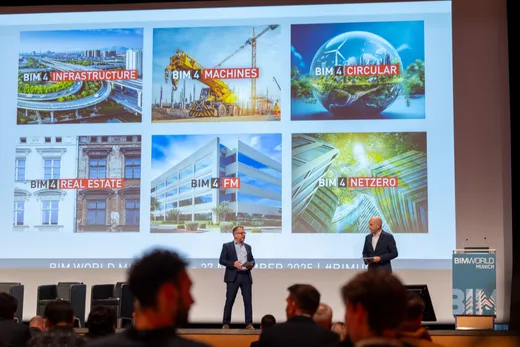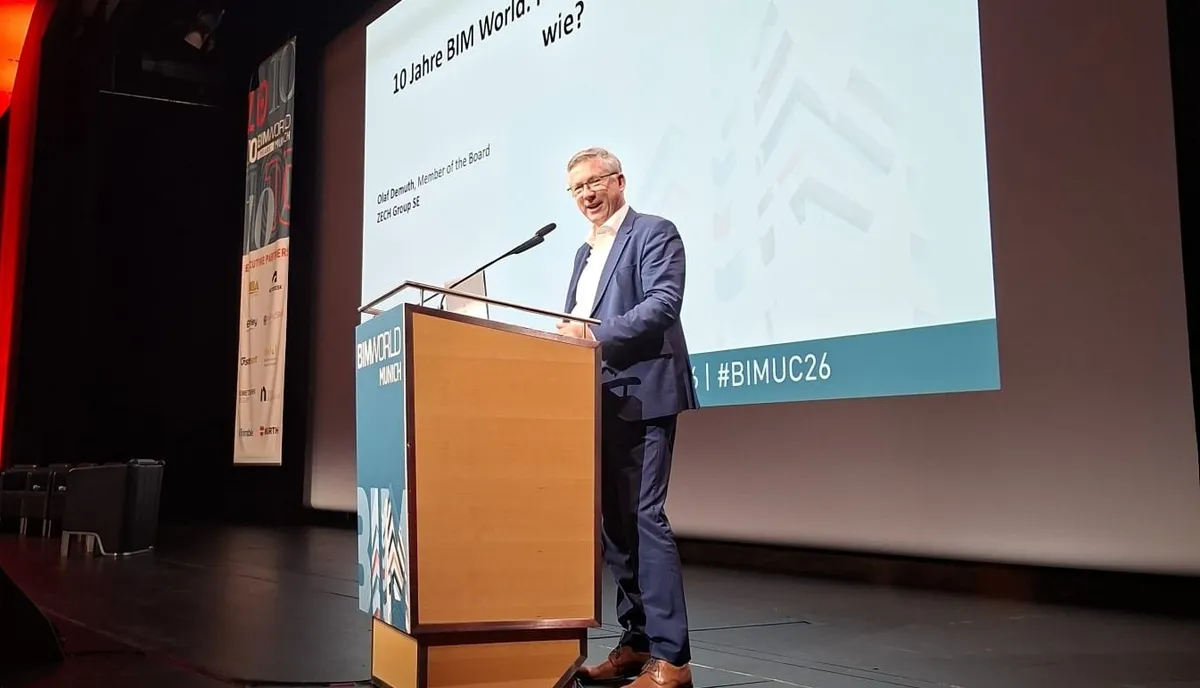
Ten years of BIM World MUNICH – for Olaf Demuth this is not only an occasion to look back on the progress of digitalization. In his opening keynote, the President of the Main Federation of the German Construction Industry focuses above all on looking ahead. “The crucial question is no longer: How digital is the construction industry? The crucial question is: How much more powerful will Germany become through the digitalization of construction?”
From his point of view, the pressure to act is enormous. Germany must renovate bridges, expand rail lines and energy grids, create housing and modernize its infrastructure – and do so in a way that is as climate-neutral and resource-efficient as possible. At the same time, demographic change is exacerbating the shortage of skilled workers. By 2035, according to Demuth’s assessment, the construction industry could be short around 200,000 employees.
Additional investments alone will therefore not solve these challenges. “The limiting factor of our future is not money. It is not capital. The limiting factor in the industry is productivity,” Demuth states. The construction sector must learn to achieve significantly more with the available workforce.
He links this to a fundamental critique of digitalization to date. In recent years, the focus has mainly been on introducing new tools: CAD, BIM, cloud platforms, digital documents and, most recently, AI assistants. Now a second phase is beginning in which the technology itself must no longer be the focus, but rather its economic benefit. “No more data for data’s sake, no more platforms for their own sake,” Demuth demands. Every digital step must prove that it creates value, shortens construction times, reduces errors or eases the workload of skilled workers.
“We have to stop viewing digitalization as an IT issue,” he warns. Digitalization has now become an industrial policy task. It affects Germany’s competitiveness just as much as the speed at which infrastructure projects and the energy transition can be implemented. Demuth describes the changes needed for this using five productivity levers.
Change processes instead of digitalizing poor workflows
Demuth sees the first and possibly most important lever in the organization of construction projects. The greatest obstacles often do not lie in missing technologies but in outdated structures. “We still often organize construction projects as if there were no digital age,” he criticizes. Planning and execution remain largely separated, information is lost at the interfaces, and contract models sometimes make collaboration more difficult.
It is therefore a misconception to want to solve such difficulties solely through new software. “A bad process does not become better through digitalization,” says Demuth. “It just becomes bad faster.” Artificial intelligence also does not turn an inefficient organization into an efficient one.
Digital tools must therefore not simply be placed on top of existing structures. Instead, the organization of the construction projects themselves must be changed. “We must rethink our organization for digital processes,” Demuth demands. This includes more integration, shared responsibility and a closer partnership between planning and execution. As possible approaches, he cites Integrated Project Delivery (IPD) and partnering models that place greater emphasis on collaboration and communication. The decisive factor is to stop optimizing individual work steps in isolation and instead optimize the entire construction process.
Record data only once – and use it many times
The second productivity lever is data handling. Demuth compares its future importance to that of concrete in building construction or asphalt in road construction: it could become a fundamental building block for productivity and value creation. Until now, however, data has often been treated like a by-product that is hardly reused after the project is completed. “And yet at the moment we often treat data like construction waste from a project,” he criticizes.
His vision is continuous use of data over the entire building life cycle. Ideally, a piece of information should be recorded only once and then be available for costing, planning, logistics, execution, operation, maintenance and deconstruction.
In many places, the reality looks different. For individual tasks there are different programs and platforms. Information has to be entered, checked, transferred and corrected multiple times. According to Demuth, around 1,200 digital tools are in use in his own company, which are used in parallel. The large number of applications therefore does not automatically lead to less work. Often, existing activities are merely represented digitally instead of actually being simplified or made unnecessary.
“The future therefore belongs to open standards,” says Demuth. What matters is a common data language that makes it possible to use information across company and project boundaries, independently of individual software solutions.
AI should take over routine work, not responsibility
Demuth sees artificial intelligence as the third productivity lever. The industry is only at the beginning of its possibilities. At the same time, he warns against both underestimating and overestimating AI. “AI will not replace the engineer on the construction site, will not replace the site manager and will not replace the cost estimator either,” Demuth is convinced. However, a significant part of their previous tasks will change. Above all, the search for information, its transfer between systems and recurring documentation and evaluation tasks can increasingly be automated. “So it will drive routine out of the work, but not responsibility.”
Demuth therefore sees the greatest benefit less in spectacular individual applications and more in numerous everyday processes: in tenders and change orders, in approval procedures, in documentation obligations or in site reports. AI can relieve skilled workers of routine tasks and give them more time for more demanding activities.
However, this requires a reliable and sovereign data basis. “An AI is only as good as the data it works on,” Demuth emphasizes. He therefore advocates developing a European, industry-specific large language model that is trained on construction and infrastructure data. Such an AI system should be based on open standards and operate in sovereign data spaces.
Data exchange without loss of control
This ties in with Demuth’s fourth lever: data exchange and data sovereignty. The construction site of the future is not an isolated place, but a networked system in which machines, supply chains, design offices, construction companies, operators and authorities exchange information with each other. For this to work, data must be available across company and system boundaries.
At the same time, sharing data must not lead to companies losing control over their knowledge. “Sharing data must not mean losing control,” Demuth makes clear. He warns against data spaces that primarily benefit a few large platform providers. After all, the value creation of the construction industry essentially arises from the knowledge of its companies.
As a possible solution approach, he mentions the research project Construct-X, which is developing a federated data infrastructure for the construction industry. Unlike a central platform, the information is meant to remain where it is generated. “Data stays where it is generated. The companies retain control and yet collaboration becomes possible,” is how Demuth describes the principle. He sees this as an important prerequisite for the digital sovereignty of the sector: companies should be able to share and jointly use information without giving up sovereignty over their data.
Robotics and automation need connected processes
The fifth productivity lever is automation. For the next ten years, Demuth expects increasing use of semi-autonomous construction machinery, robotic systems for recurring tasks, automated construction site logistics, and digital twins for controlling and monitoring projects. But here too he warns against relying solely on the performance of individual technologies. An automated machine cannot exploit its potential if it lacks the necessary data. Nor does automated production help if the required material is not available on time.
“Productivity does not arise from individual technologies. Productivity arises from their interaction,” Demuth emphasizes. For him, the success of automation therefore depends directly on how well planning information, machines, supply chains, and construction site processes are connected to one another. The use of robotics and autonomous systems must therefore be part of a more comprehensive reorganization of construction processes. Only through networking does the targeted productivity gain emerge.
Clear demands on technology providers
At the end of his keynote, Demuth addresses four concrete expectations to the companies that develop digital solutions for the construction industry. At the top of the list is interoperability. “Do not develop data silos, but real interoperability with open interfaces,” he demands. These must become the standard rather than remain the exception. He also calls for a rethinking in the development of new applications: “Put productivity above function.” It should not be the longest list of technical features that decides the choice of software, but its actual economic benefit. The decisive factor is how many working hours can be saved through its use.
His third demand concerns data sovereignty. Process and production data belong to the companies that generate them. They may therefore not be used for training AI systems without the companies’ consent. “Their use for AI training may only take place with explicit consent,” Demuth makes clear. Fourth, technology providers and the construction industry should work together on a sovereign European digital construction infrastructure. The sector must not become dependent on a few proprietary platforms.
Productivity will determine the next decade
For the year 2036, Demuth paints a picture of a construction industry in which information no longer has to be constantly transferred between people and systems. “I see a construction industry that, despite having fewer workers available—which we will certainly have then—creates more infrastructure and can provide more housing,” is how Demuth describes his vision. An industry that builds faster, more precisely, and with greater resource efficiency, and can thus become a driver of innovation for Germany. His central message for the tenth anniversary of BIM World MUNICH is at the same time a call to measure the success of digitalization differently in the future: not by the number of applications introduced or the volume of data generated, but by their actual contribution to construction output. “Our goal must therefore not be to manage more data. Our goal must be to build more.”
 Rudolf Müller Event GmbH
Datenaustausch ohne Kontrollverlust
Daran knüpft Demuths vierter Hebel an: Datenaustausch und Datensouveränität. Die Baustelle der Zukunft sei kein isolierter Ort, sondern ein vernetztes System, in dem Maschinen, Lieferketten, Planungsbüros, Bauunternehmen, Betreiber und Behörden Informationen miteinander austauschen. Damit dies funktioniert, müssten Daten über Unternehmens- und Systemgrenzen hinweg verfügbar sein.
Gleichzeitig dürfe ihre Weitergabe nicht dazu führen, dass Unternehmen die Kontrolle über ihr Wissen verlieren. „Daten teilen darf nicht bedeuten, Kontrolle zu verlieren“, stellt Demuth klar. Er warnt vor Datenräumen, die vor allem wenigen großen Plattformanbietern zugutekommen. Schließlich entstehe die Wertschöpfung der Bauwirtschaft wesentlich aus dem Wissen ihrer Unternehmen.
Als möglichen Lösungsansatz nennt er das Forschungsprojekt Construct-X, das eine föderierte Dateninfrastruktur für die Bauwirtschaft entwickelt. Anders als bei einer zentralen Plattform sollen die Informationen dort verbleiben, wo sie entstehen. „Daten bleiben dort, wo sie entstehen. Die Unternehmen behalten die Kontrolle und trotzdem wird Zusammenarbeit möglich“, beschreibt Demuth das Prinzip. Darin sieht er eine wichtige Voraussetzung für die digitale Souveränität der Branche: Unternehmen sollen Informationen miteinander teilen und gemeinsam nutzen können, ohne die Hoheit über ihre Daten aufzugeben.
Robotik und Automatisierung brauchen vernetzte Prozesse
Der fünfte Produktivitätshebel ist die Automatisierung. Für die kommenden zehn Jahre erwartet Demuth einen zunehmenden Einsatz teilautonomer Baumaschinen, robotischer Systeme für wiederkehrende Tätigkeiten, automatisierter Baustellenlogistik und digitaler Zwillinge zur Steuerung und Überwachung von Projekten. Doch auch hier warnt er davor, allein auf die Leistungsfähigkeit einzelner Technologien zu setzen. Eine automatisierte Maschine könne ihr Potenzial nicht ausschöpfen, wenn ihr notwendige Daten fehlen. Ebenso wenig helfe eine automatisierte Fertigung, wenn das benötigte Material nicht rechtzeitig bereitsteht.
„Produktivität entsteht nicht durch Einzeltechnologien. Produktivität entsteht durch deren Zusammenspiel“, betont Demuth. Für ihn hängt der Erfolg der Automatisierung deshalb unmittelbar davon ab, wie gut Planungsinformationen, Maschinen, Lieferketten und Baustellenprozesse miteinander verbunden werden. Der Einsatz von Robotik und autonomen Systemen müsse somit Teil einer umfassenderen Neuorganisation der Bauprozesse sein. Erst durch die Vernetzung entstehe der angestrebte Produktivitätsgewinn.
Klare Forderungen an die Technologieanbieter
Zum Abschluss seiner Keynote richtet Demuth vier konkrete Erwartungen an die Unternehmen, die digitale Lösungen für die Bauwirtschaft entwickeln. An erster Stelle steht die Interoperabilität. „Entwickeln Sie keine Datensilos, sondern echte Interoperabilität mit offenen Schnittstellen“, fordert er. Diese müssten zum Standard werden, statt eine Ausnahme zu bleiben. Auch bei der Entwicklung neuer Anwendungen fordert er ein Umdenken: „Stellen Sie Produktivität über Funktion.“ Nicht die längste Liste technischer Funktionen solle über die Auswahl einer Software entscheiden, sondern ihr tatsächlicher wirtschaftlicher Nutzen. Maßgeblich sei, wie viele Arbeitsstunden sich durch ihren Einsatz einsparen lassen.
Seine dritte Forderung betrifft die Datensouveränität. Prozess- und Produktionsdaten gehörten den Unternehmen, die sie erzeugen. Für das Training von KI-Systemen dürften sie deshalb nicht ohne deren Einwilligung verwendet werden. „Ihre Nutzung für KI-Training darf nur mit ausdrücklicher Zustimmung erfolgen“, stellt Demuth klar. Viertens sollten Technologieanbieter und Bauwirtschaft gemeinsam an einer souveränen europäischen digitalen Bauinfrastruktur arbeiten. Die Branche dürfe nicht von wenigen proprietären Plattformen abhängig werden.
Die Produktivität entscheidet über die nächste Dekade
Für das Jahr 2036 zeichnet Demuth das Bild einer Bauwirtschaft, in der Informationen nicht mehr ständig zwischen Menschen und Systemen übertragen werden müssen. „Ich sehe eine Bauwirtschaft, die trotz weniger zur Verfügung stehender Arbeitskräfte, die wir sicher dann haben, mehr Infrastruktur schafft und mehr Wohnraum zur Verfügung stellen kann“, beschreibt Demuth seine Vision. Eine Branche, die schneller, präziser und ressourcenschonender baut und damit zu einem Innovationsmotor für Deutschland werden könne. Seine zentrale Botschaft zum zehnjährigen Jubiläum der BIM World MUNICH ist damit zugleich eine Aufforderung, den Erfolg der Digitalisierung künftig anders zu messen. Nicht an der Zahl eingeführter Anwendungen oder erzeugter Daten, sondern an ihrem tatsächlichen Beitrag zur Bauleistung. „Unser Ziel darf es also nicht sein, mehr Daten zu verwalten. Unser Ziel muss es sein, mehr zu bauen.“