A ventilation unit, a pumping system or a drainage system can now often be configured in numerous variants. Dimensions, performance requirements, accessories and technical conditions determine which version is suitable for a construction project. For MEP designers, this often means time‑consuming research. Product catalogues have to be compared, technical data checked and configurations matched with the requirements of the project. For more complex products, additional support from the manufacturer’s technical sales department is required. The challenge here is not necessarily a lack of information. Rather, this information is often spread across different documents and systems and can only be applied correctly with the appropriate expertise.
Product knowledge becomes a digital service
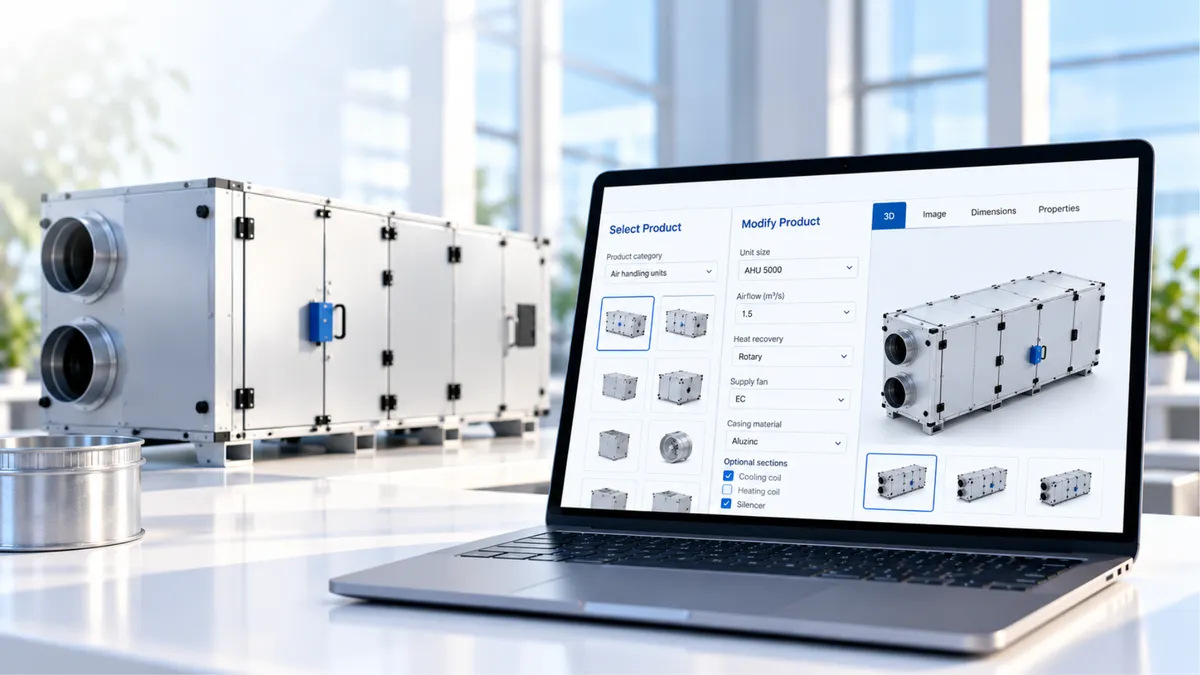
Digital product configurators give manufacturers the opportunity to deliberately reduce this complexity. Instead of merely providing users with technical data and lists of variants, they guide them through a structured selection process. To this end, the manufacturer’s technical rules, calculations and configuration options are mapped in a digital application. The user enters, for example, the required air volume, available installation dimensions or other project‑specific parameters. The system then supports them in determining a technically suitable product configuration.
In this way, manufacturers offer an additional customer service. Recurring selection tasks can be digitally supported, while product specialists gain more time for demanding technical questions. At the same time, valuable product knowledge becomes accessible independently of individual consultation meetings and can be reused for numerous customer enquiries.
When product selection becomes part of BIM planning
This approach becomes particularly interesting when digital configurators are linked with Building Information Modeling (BIM). In many planning processes, product selection still takes place outside the BIM software. Designers transfer requirements into a separate selection tool and then have to import the results back into the building model. A BIM‑integrated product configurator can connect these work steps. Project information can be used for product selection. The selected configuration can then be transferred into the digital planning process together with the relevant technical information.
This not only improves manufacturers’ access to their product portfolio. It also creates the conditions for their products to be taken into account early in the planning process and to be selected for tenders.
From planning to quotation
The benefits of digital configuration logic do not have to end with MEP planning. The same product rules can also be used in sales processes. In so‑called CPQ solutions (Configure, Price, Quote), product configuration, price calculation and quotation creation are linked together. Sales teams and trading partners can thus rely on a common technical basis instead of maintaining product rules separately in different systems. This opens up a broader perspective for manufacturers: a digital product configurator is not only a tool for customers, but can also improve the connection between product development, planning and sales.
Translating technical expertise into usable software
However, developing such solutions requires more than programming skills. It is crucial to understand both the technical properties of the manufacturer’s products and the workflows of MEP designers. This is where the MagiCAD Group comes in with its digital solutions for MEP manufacturers. The company combines experience in the development of MEP planning software with the services of MagiCAD Cloud.
Depending on the initial situation, manufacturers can, for example, develop BIM‑integrated configurators as a web‑based MagiCAD Cloud Selection Tool, or integrate existing selection programs into planning software via MagiCAD Cloud plugins and reuse their configuration logic for CPQ processes. The focus is not on a specific software feature, but on the question of which digital workflow actually makes product selection easier for customers.
The digitalisation of product selection therefore does not begin with the decision in favour of a configurator, but with an understanding of the existing processes. Manufacturers who deliberately make their technical product rules digitally usable can improve collaboration with designers and at the same time create a common basis for further digital services.