Trains come and go, travelers switch between platforms, shops remain open, technical systems must function. At the same time, planning, construction, maintenance, and renovation are taking place. At Hamburg Central Station, two requirements meet that are hard to separate: the station must change, but it must not stop functioning during this time.
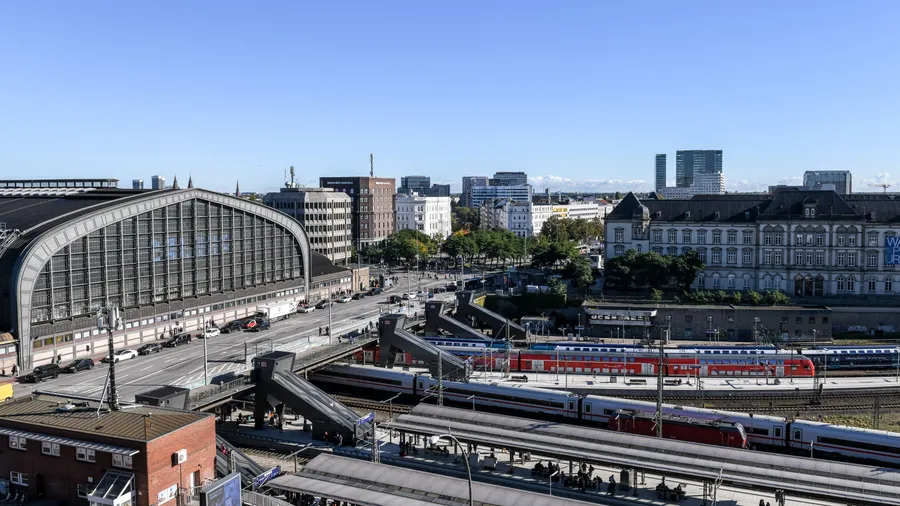
With over half a million people daily, Hamburg Central Station counts as one of the busiest railway hubs in Europe. This presents exceptional infrastructural challenges for ongoing operations and continuous maintenance. A variety of projects with different orientations and clients are planned or intended for the coming years. These projects influence each other and must therefore be coordinated across the board. If multiple construction measures simultaneously claim the same traffic, logistics, or assembly areas, construction sites can overlap. Without coordinated management, there are safety risks for passengers or costly operational interruptions. At the same time, station management must ensure ongoing building operations.
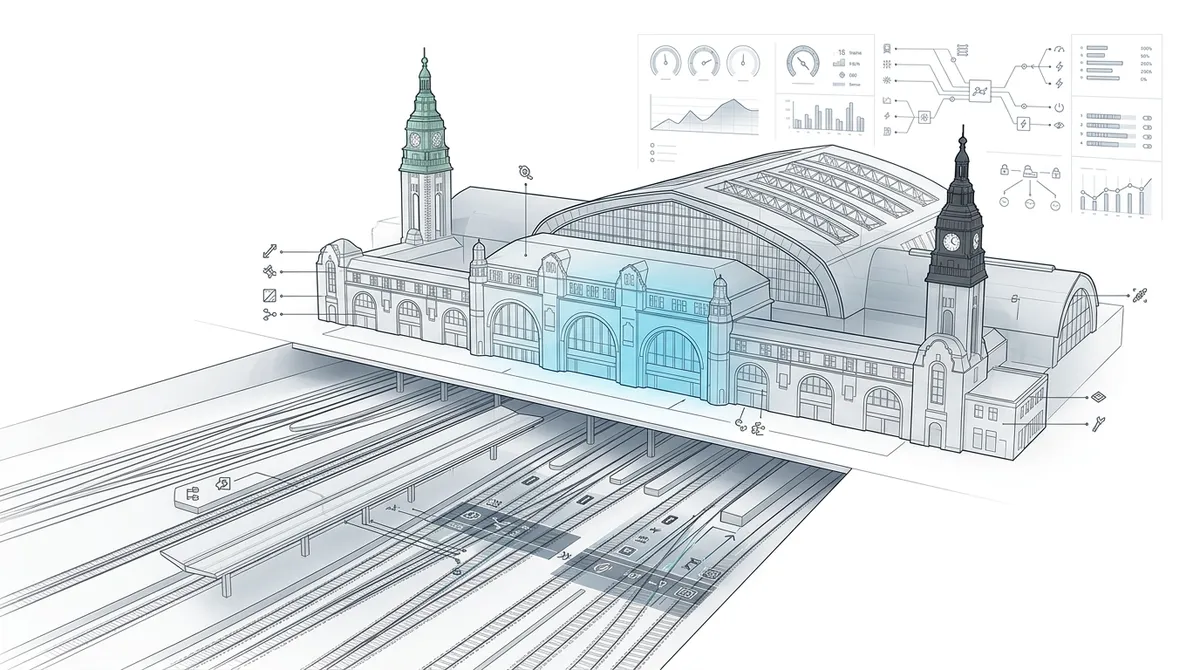
A Digital Twin (DT) can serve as a central methodological solution for this multiproject complexity. It fundamentally differs from a static Building Information Modeling (BIM) building data model. A BIM model represents the geometry and properties of a structure at a specific reference date. A Digital Twin goes further: it continuously links the physical structure with its virtual model and adds a fourth dimension:
In a complex transport hub like Hamburg Central Station, it is not enough to consider only space. Time also becomes a planning factor. The spatial-temporal overlap of multiple projects at complex transport hubs like Hamburg Central Station requires model-based 4D methods. Here, the three-dimensional models are linked with their respective schedules. This not only shows where construction is taking place, but also when certain areas or spaces are needed. Model-based coordination of construction, logistics, and traffic areas during ongoing operations is possible, identifying technical dependencies and synergies.
A centrally maintained data foundation also prevents the need for multiple collection of existing information. It also allows future states to be simulated and planning to be based on current rather than outdated existing data. After project completion, the data should seamlessly transition into operation. This includes updated as-built geometries depicting the actual condition executed, as well as maintenance data for systems like SAP-PM and information as a basis for defects and warranty management.
 Pexels / Wolfgang Weiser
4D multiproject synchronization in the Digital Twin
In the course of cross-project BIM management, those responsible for the project have worked on establishing a model-based synchronization of existing inventory, operations, and all planned construction measures. This allows construction and operational concerns to be dynamically linked. The goal is to manage construction and maintenance measures so that the operation of the Hamburg Central Station transport hub is continuously ensured.
The basis for the planning and synchronization of project models consists of semantic inventory models. They contain not only the geometry of a component but also information about what the component is and its properties. This forms the common foundation for the technical and temporal planning of construction measures that interfere with operations. To initiate inventory models, the structural structures and technical systems of the entire station must be recorded geometrically and semantically.
However, this semantic modeling alone is not enough to manage multiple projects simultaneously. Integrated 4D modeling is also required, linking the geometric 3D sub-models of all individual projects with their respective timelines and projecting up to a decade into the future. To automatically and rule-based identify spatial usage conflicts, the model does not limit itself to the components that will be permanently present later. It also explicitly includes temporary construction site facilities, logistics pathways, scaffolding structures, and workspaces. These temporary areas can be represented as digital placeholders in the model using standardized space objects. For example, it becomes visible when one project needs scaffolding at a location while another project plans a transport route there at the same time. Spatially both would be possible, but the projects collide temporally.
External video from Vimeo - loads only after you click. Privacy policy
Cross-project Virtual Design Reviews (VDR) and model inspections
To ensure that the 4D model is not just a technical planning aid, but actually flows into project management, it is incorporated into cross-project Virtual Design Reviews (VDR). These are joint coordination sessions in which the models are analyzed spatially and temporally. The process follows a clearly defined three-stage sequence:
- Preparation: The sub-project managers deliver their current status reports and updated 4D sub-models to a central collaboration platform. Checks are made regarding data quality and 4D collisions.
- Execution: In the VDR meeting, the consolidated models are visually and temporally analyzed. Through predefined viewpoints and dynamic cross-sectional levels, geometric and temporal interfaces are transparently discussed.
- Follow-up: Identified conflicts or further insights are created as BCF in a CDE and controlled until they are resolved or documented for future use in a model-related manner. The vendor-neutral exchange format allows tasks and issues to be directly connected to a specific point or view in the BIM model without having to exchange the entire model.
In the course of model inspections by cross-project BIM management, rule-based 4D collision checks were performed. It extends the classic 3D collision check by time. The analysis thus also recognizes dynamic spatial-temporal conflicts that arise when two objects or placeholders claim the same area at the same time. All inconsistencies are captured, referenced, and tracked as structured topics in the vendor-neutral Building Collaboration Format (BCF).
Intuitive data integration for station management
Another requirement besides multiproject management was to provide employees at station management with inventory geometry and current information about inventory on mobile devices. Access to the digital twin should therefore be available on mobile devices with an intuitive user interface. Due to a bidirectional link of 3D inventory models with the ERP system SAP-PM, operational maintenance personnel can also access both locatable master data of technical equipment and current movement data such as fault reports, maintenance plans, and inspection protocols on mobile devices. This forms the basis for targeted maintenance processes and responsive repair handling.
In the future, the digital twin may be linked with defect and warranty management so that processing progress can be tracked specifically by object. Station management, as the station operator, can thus track the condition of the station in real time.
Another use case for the digital twin is the consolidation of distributed geometry and contract data from gastronomy and retail spaces into a so-called shop profile. This includes all relevant information for a rental space, which is relevant for both marketing and management.
 albert.ing
1 / 4
 albert.ing
2 / 4
 albert.ing
3 / 4
 albert.ing
4 / 4
Conclusion: Insights, Scalability, and Further Development
Implementing a digital twin for Hamburg Central Station requires overcoming complex hurdles:
- The inventory must be captured both geometrically and alphanumerically, different IT systems and interfaces must interact. Additionally, there is an organizational shift towards a more data-based collaboration.
- These efforts are offset by essential benefits. Central, redundancy-free data use reduces costs and optimizes project coordination. Simulations on the twin model also help coordinate parallel construction projects and ongoing operations and provide the station management with the necessary information.
A prerequisite for successful implementation is a structured, step-by-step approach:
- First, goals, involved actors, and prioritized use cases are defined.
- This is followed by the analysis of existing data sources and processes.
- Only on this basis are systems selected, interfaces developed, and the necessary IT ecosystem built.
In summary, it is clear that a digital twin of Hamburg Central Station is far more than a technological representation – it is the central strategic tool for holistic, collaborative information and operations management of the future.